


Chapitre 2 — Les outils du tireur de précision
Chapter 2 — The Tools of the Precision Marksman
La qualité de votre production est irrévocablement liée à la qualité de vos outils. La poursuite de l'absolu — le groupement en un seul trou — exige des instruments conçus avec des tolérances minimales et une répétabilité maximale.
Les presses de rechargement
La presse est le moteur du processus. Sa fonction principale est de fournir un mouvement vertical parfaitement linéaire sous pression mécanique significative.
Presses monopostes filetées (7/8''-14)
Parmi les designs les plus distinctifs, la Forster Co-Ax se distingue des presses traditionnelles en « O » ou « C ». Elle utilise un système à double guide et une mâchoire universelle qui permet au shellholder de flotter légèrement, favorisant l'auto-alignement de la douille et de la matrice et réduisant les erreurs de concentricité.
Les presses lourdes en fonte (RCBS Rock Chucker, Redding UltraMag) privilégient masse et rigidité, minimisant la flexion même lors du recalibrage de grosses douilles magnum.
La dernière génération (Area 419 ZERO) utilise un usinage aérospatial et des roulements linéaires, éliminant le jeu mécanique des presses traditionnelles.
Presses à levier (Arbor Press)
Utilisant des « hand dies » (L.E. Wilson), la presse à levier fournit une force verticale directe. Sans le levier mécanique massif d'une presse filetée, le rechargeur peut sentir la résistance du projectile entrant dans le collet — le meilleur moyen d'identifier une tension de collet inconsistante.
La science du calibrage : les matrices
Matrices à bushing
Les matrices traditionnelles utilisent un diamètre interne fixe, ce qui « surtravaille » souvent le collet. Les matrices à bushing permettent de changer les bagues internes par incréments de 0,001'' (0,025 mm), offrant un contrôle précis de la tension de collet — la prise du laiton sur le projectile.
Matrices de mise en place (seating dies)
Les matrices de compétition (Redding, Forster) utilisent un manchon interne coulissant qui supporte le corps de la douille avant que le piston n'entre en contact avec le projectile, assurant la coaxialité.
Les têtes micrométriques offrent un contrôle granulaire, typiquement 0,001'' (0,025 mm) par graduation, essentiel pour explorer la relation entre profondeur de balle et précision.
Outillage de préparation
L'ébarbeuse L.E. Wilson
Le trimmer Wilson tient la douille dans un support spécifique au calibre qui reproduit la conicité de la chambre, assurant que la douille est parfaitement perpendiculaire à la fraise. Résultat : une bouche de douille parfaitement plate et à 90° du corps.
Outils d'uniformisation
- Uniformiseur de logement d'amorce : fraise carbure assurant une profondeur identique pour chaque logement, permettant une précharge mécanique uniforme de l'enclume de l'amorce.
- Ébavurage du trou de flamme : la bavure laissée par le poinçonnage peut dévier la flamme d'amorçage. Son retrait assure un chemin de flamme centré et uniforme.
Instruments de mesure
Dosage de la poudre
La masse de charge commande la vitesse initiale, et la finesse avec laquelle on tient la première fixe un plancher sous la régularité de la seconde. Deux technologies se partagent l'établi : la balance mécanique à fléau et la balance électronique.
Combien coûte une erreur de pesée ? La réponse n'est pas une constante, et il vaut mieux en connaître l'ordre de grandeur avant de choisir une balance. En ajustant les 291 escaliers de charge publiés dont nous disposons, sur six cartouches, la pente médiane est de 72 fps par grain de poudre — mais la dispersion est large et elle suit la capacité de l'étui : environ 27 fps/gr sur une .338 Norma Magnum, 66 sur une 6,5 × 47 Lapua, 88 sur une 6 mm BR, et 200 fps/gr sur une .221 Fireball. Un petit étui sanctionne une erreur de pesée environ sept fois plus durement qu'un gros.
| Erreur de pesée | Étui courant | Petit étui (.221 Fireball) |
|---|---|---|
| ± 0,1 gr (balance à fléau) | ± 7 fps | ± 20 fps |
| ± 0,02 gr (balance EMFR) | ± 1,4 fps | ± 4 fps |
À rapporter à un écart-type de vitesse de qualité match, de l'ordre de 3,5 m/s (11 fps). Comme ce sont les variances qui s'additionnent et non les écarts, une balance à fléau tenue à ± 0,1 gr pèse pour environ un tiers de cette variance sur un étui courant — une cible d'amélioration réelle. Une balance EMFR tenue à ± 0,02 gr n'en représente que quelques pour cent, et à ce stade la charge n'est plus ce qui vous limite : la seule température de la poudre (chapitre 8) déplace la vitesse de 0,5 à 1,3 fps par degré Celsius, si bien qu'un écart de dix degrés dans une journée de match pèse davantage. La conclusion n'est pas que la pesée ne compte pas : c'est qu'elle cesse d'être la variable limitante dès qu'on pèse bien, et que plus l'étui est petit, plus ce moment arrive tard.
Le détail des deux technologies — principe du fléau, capteur hybride des balances de laboratoire, protocole de contrôle croisé — est traité au chapitre 4, avec l'opération de dosage elle-même.
Pieds à coulisse et micromètres
Un pied à coulisse de précision (0,001'' en pouces, 0,01 mm en métrique — ce sont les deux résolutions courantes, et elles ne sont pas équivalentes : 0,001'' vaut 0,0254 mm) est l'instrument de base : longueur totale, longueur de douille, datum d'épaulement. Un micromètre (résolution 0,0025 mm / 0,0001'') est essentiel pour mesurer l'épaisseur de paroi de collet et les diamètres de projectile.
Combinés à des accessoires spécialisés (comparateur de balle mesurant à l'ogive, comparateur de headspace mesurant au datum d'épaulement), ils deviennent un système complet d'analyse géométrique.
Résumé de l'outillage essentiel
| Catégorie | Exigence de précision | Exemple préféré |
|---|---|---|
| Presse | Zéro flexion / auto-alignement | Forster Co-Ax / Area 419 ZERO |
| Matrices | Contrôle du collet par bushing | Redding Type S / Wilson Hand Dies |
| Ébarbeuse | Perpendicularité au corps | L.E. Wilson Case Trimmer |
| Balance (électronique) | Sensibilité 0,02 gr | A&D FX-120i (capteur hybride) |
| Balance (à fléau) | Résolution 0,1 gr | RCBS 505 / Redding No. 2 |
| Pied à coulisse | Résolution 0,001'' | Mitutoyo Absolute Digital |
In the world of precision handloading, the quality of your output is irrevocably linked to the quality of your tools. While it is true that a skilled reloader can produce acceptable ammunition with basic equipment, the pursuit of the absolute—the "one-hole" group—requires instruments that are designed with minimal tolerances and maximum repeatability. This chapter provides a deep exploration of the essential hardware required for precision work, moving beyond simple descriptions into the mechanical theories and practical advantages of each.
The Core of the Bench: Reloading Presses
The press is the engine of the reloading process. Its primary function is to provide perfectly linear vertical movement under significant mechanical pressure. For the precision handloader, the choice usually narrows down to high-quality single-stage presses. Progressive presses, while excellent for high-volume pistol or tactical rifle shooting, typically introduce too many mechanical variables for the extreme accuracy required in benchrest or long-range competition.
Threaded Single-Stage Presses (7/8”-14)
Standard threaded presses are the workhorses of the industry. They utilize the universal 7/8”-14 thread pitch for mounting dies. Among the most distinctive designs is the Forster Co-Ax, which stands apart from the traditional “O” or “C” frame presses. The Co-Ax uses a dual-guide rod system and a universal jaw that allows the shellholder to float slightly. This float permits the case and the die to self-align during the sizing operation, significantly reducing the introduction of concentricity errors—a feature that is particularly valuable for shooters who do not use custom-fitted dies.
At the other end of the design spectrum, heavy cast iron presses such as the RCBS Rock Chucker or the Redding UltraMag prioritize sheer mass and rigidity. Their heavy frames minimize flexing even when resizing large magnum cases, ensuring that the headspace and shoulder bump set in the die remain consistent throughout a 100-round lot.
The most recent generation of presses, represented by units like the Area 419 ZERO, applies aerospace-grade machining and linear bearings to the reloading press. These designs eliminate the mechanical play found in traditional cast units, providing a level of repeatability previously only available in custom-made tools. For the shooter willing to invest in the finest equipment, these modern presses represent the state of the art.
Arbor Presses and Hand Dies
Arbor presses represent a fundamentally different approach to reloading. Instead of threaded dies, they utilize “hand dies” pioneered by L.E. Wilson. The arbor press provides a simple, direct vertical force, and because it lacks the massive mechanical leverage of a threaded press, the reloader can feel the resistance of the bullet as it enters the case neck. This tactile feedback is one of the best ways to identify inconsistent neck tension—a critical variable in velocity consistency. A case with a neck that is too tight or too loose will feel distinctly different under the press, alerting the experienced reloader to a problem that might otherwise go undetected.
Hand dies also offer an inherent alignment advantage. Because the die completely captures the case within a precision-machined sleeve, and because it is not threaded into a press frame, the alignment is governed solely by the interface between the die and the case. The result is often superior concentricity compared to threaded dies, making the arbor press a favorite of benchrest competitors who demand the absolute minimum runout in their finished ammunition.
The Science of Sizing: Reloading Dies
The die is the most precise component of the reloading system. It is responsible for reshaping the brass back to a chamber-compatible state while maintaining the integrity of the cartridge’s centerline.
Bushing Dies: Controlling the Neck
Traditional sizing dies utilize a fixed-diameter internal neck. This often results in the neck being “over-worked”—sized down too small and then expanded back up with an internal expander ball. Precision shooters utilize Bushing Dies, which allow the user to swap out internal bushings in 0.001” increments. This allows for precise control of “neck tension”—the amount of grip the brass has on the bullet. By sizing the neck only as much as necessary, you extend the life of your brass and improve the uniformity of bullet release.
Seating Dies: The Final Alignment
The seating die must ensure that the bullet is started perfectly straight and pushed to a consistent depth. Advanced competition seating dies from Redding and Forster achieve this through a sliding internal sleeve that supports the entire case body before the seating stem makes contact with the bullet. This pre-alignment ensures that the bullet and case are coaxial before the final seating pressure is applied, preventing the introduction of runout at the very last step of the loading process.
Equally important is the ability to make fine, repeatable adjustments to seating depth. Micrometer-style die tops provide granular control, typically with 0.001” per graduation, allowing the reloader to explore the relationship between seating depth and accuracy with laboratory precision. This capability is essential for the “tuning” phase of load development, where finding the specific bullet-to-rifling distance that a particular rifle prefers can transform a good load into an exceptional one.
Case Preparation Tooling
Consistency in case dimensions is the hallmark of the precision reloader. This requires tools that can trim, chamfer, and uniform brass with laboratory accuracy.
The L.E. Wilson Case Trimmer
While many trimmers utilize a collet to hold the case head, the Wilson trimmer holds the case in a caliber-specific holder that mimics the taper of the rifle chamber. This ensures the case is perfectly square to the cutter. When the cutter makes contact, it trims the case mouth perfectly flat and at a precise 90-degree angle to the body—a small detail that ensures uniform bullet release and consistent pressure.
Uniforming Tools
Precision work often involves “cleaning up” the manufacturing defects present even in high-quality commercial brass. Primer pocket uniformers—small carbide cutters—ensure that every primer pocket is machined to an identical depth. This allows the primer’s anvil to be seated with consistent mechanical preload, which is the key to uniform ignition. Flash hole deburring tools address a related issue: the punching process used to create the flash hole in most commercial brass leaves a small burr on the interior wall. This burr can deflect or partially obstruct the primer’s flame as it enters the powder column. Removing it ensures an even, centered flame path, reducing the velocity variance that stems from inconsistent ignition.
Measurement: The Eyes of the Reloader
You cannot manage what you cannot measure. A precision bench requires high-end measuring instruments.
The Geometry of Quantity: Powder Handling
Charge weight drives muzzle velocity, and how tightly you can hold the first sets a floor under how tightly you can hold the second. Two fundamentally different technologies compete on the reloading bench: mechanical beam scales and electronic scales.
How much does a weighing error actually cost? The answer is not a constant, and it is worth having the order of magnitude before choosing a scale. Fitting the published charge ladders we hold—291 ladders across six cartridges—gives a median slope of 72 fps per grain of powder, but the spread is wide and it tracks case capacity: about 27 fps/gr in a .338 Norma Magnum, 66 in a 6.5\(\times\)47 Lapua, 88 in a 6 mm BR, and 200 fps/gr in a .221 Fireball. A small case punishes a weighing error roughly seven times harder than a large one.
| Weighing error | Typical case | Small case (.221 Fireball) |
|---|---|---|
| \(\pm 0.1\) gr (beam scale) | \(\pm 7\) fps | \(\pm 20\) fps |
| \(\pm 0.02\) gr (EMFR scale) | \(\pm 1.4\) fps | \(\pm 4\) fps |
Set these against a match-grade velocity standard deviation, which runs around 3.5 m/s (11 fps). Because variances add rather than magnitudes, a beam scale held to \(\pm 0.1\) gr accounts for something like a third of that variance in a normal case—a real and worthwhile target for improvement. An EMFR scale held to \(\pm 0.02\) gr accounts for a couple of percent, at which point the charge is no longer what limits you: powder temperature alone (Chapter [ch:environment]) moves velocity by 0.5 to 1.3 fps for every degree Celsius, so a ten-degree swing across a match day outweighs it. The conclusion is not that weighing does not matter; it is that weighing stops being the limiting variable once you weigh well, and that the smaller the case, the later that point arrives.
Mechanical Beam Scales
The mechanical beam scale—also called a balance scale—has been the reloader’s standard since the earliest days of handloading. Its principle is elegantly simple: an unknown powder charge in the pan is balanced against calibrated counterweights sliding along a graduated beam. When the beam settles to its zero mark, the weight of the charge equals the sum of the counterweight positions.
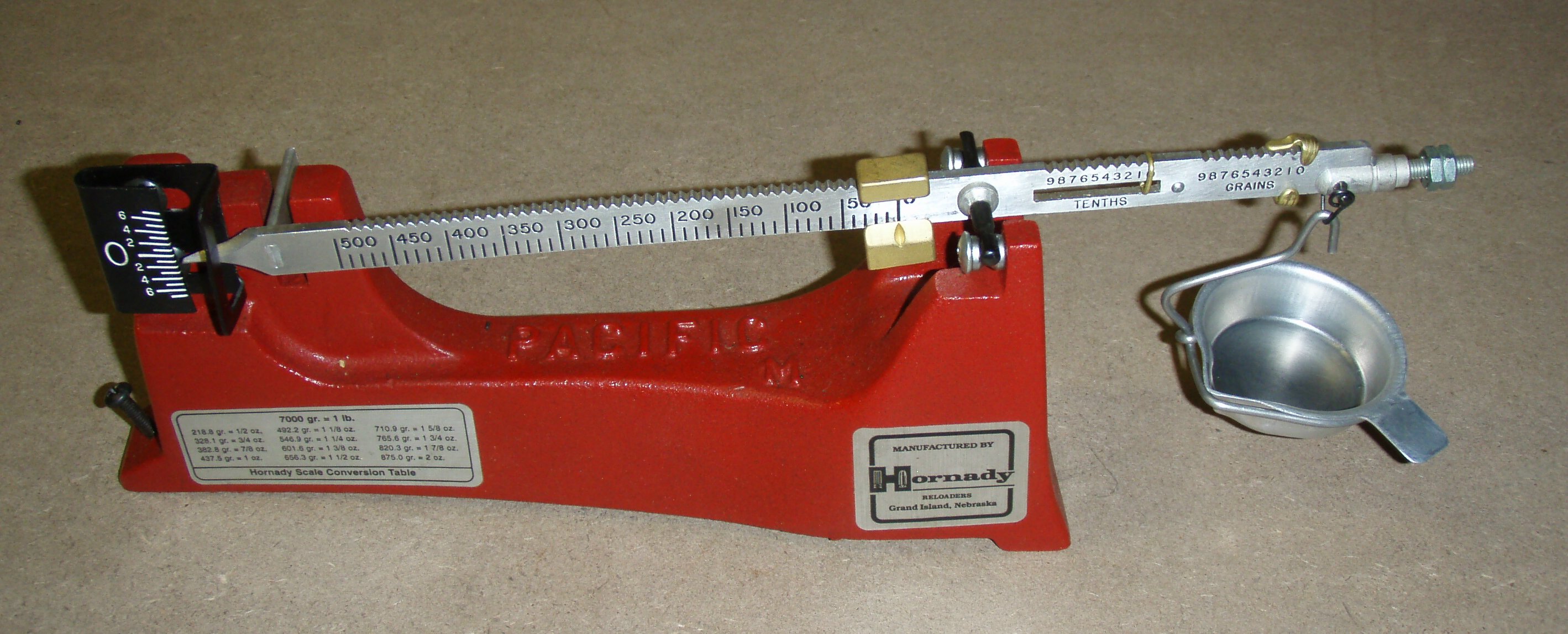
Quality beam scales such as the RCBS 505, Redding No. 2, or Hornady Balance typically resolve to 0.1 grains and are accurate to \(\pm 0.1\) grains when properly leveled and zeroed. A magnetic damper accelerates beam settling, reducing the time per charge. Beam scales have three decisive advantages: they require no power source, they never drift or need recalibration in the field, and they provide a first-principles measurement that is immune to electronic interference. For these reasons, even reloaders who have adopted electronic dispensers keep a beam scale on the bench as an independent verification tool.
Their limitation is speed: manually trickling powder onto the pan and waiting for the beam to settle is inherently slower than an automated dispenser. For a precision shooter loading 20 rounds for a match, this is acceptable; for someone loading 200 rounds for a training session, it becomes a bottleneck.
Electronic Scales and Automated Dispensers
Modern electronic scales have transformed the reloading bench. Digital dispensers like the RCBS ChargeMaster or AutoTrickler operate in two stages: a fast volumetric throw that brings the charge close to the target weight, followed by a slow gravimetric “trickle” that adds individual kernels until the exact weight is reached.
The highest-precision electronic scales, such as the A&D FX-120i, do not rely on a strain gauge alone. Their sensor is a hybrid: it combines electromagnetic force restoration—which supplies the resolution—with a parallelogram load-cell structure that supplies the settling speed. That pairing is exactly why such a scale works with an automated trickler, where a pure force-restoration balance would be accurate but too slow to follow the kernels. In grain mode the FX-120i displays in steps of 0.02 grains, five times finer than the best beam scale, which is enough to see a single kernel of extruded powder land in the pan. When paired with an automated trickler, they deliver \(\pm 0.02\)-grain consistency at a rate of one charge every 15–20 seconds, a combination of speed and precision that no manual method can match.
However, electronic scales are susceptible to environmental factors that do not affect beam scales: temperature drift, electromagnetic interference from nearby motors or fluorescent lights, air currents from HVAC systems, and the static electricity generated by many powder types. Periodic verification against a set of certified check weights is essential.
Practical Recommendations
The ideal bench setup combines both technologies. Use an electronic dispenser for primary charging and keep a beam scale zeroed and ready as a cross-check. Verify the electronic scale against check weights at the start of every session and spot-check charges on the beam scale every 10–20 rounds. This dual approach catches electronic drift before it contaminates a batch.
Two additional hazards deserve emphasis. First, never leave powder in a measuring hopper overnight. Many modern propellants are “double-base,” containing both nitrocellulose and nitroglycerin. The nitroglycerin can chemically react with inexpensive plastics—particularly those containing polystyrene—leading to etching, clouding, or permanent deformation of the hopper. Always return powder to its original factory container immediately after a loading session. Second, static electricity is the invisible enemy of consistent charges: it causes powder kernels to cling to hopper walls and scale pans, producing charges that are either consistently light or erratic. Wiping down equipment with anti-static dryer sheets, maintaining adequate room humidity, or using grounded metal scale pans can mitigate this effect.
The Micrometer and Caliper
A precision caliper (digital or dial, with 0.001” resolution) is the workhorse measuring instrument on any reloading bench. It is used to measure overall cartridge length, case length, shoulder datum, and a host of other critical dimensions. For the highest accuracy, a Mitutoyo or Starrett digital caliper with an absolute encoder is preferred, as it does not lose its zero position even when the battery is removed.
However, a caliper alone is not sufficient for all measurements. A micrometer (with 0.0001” resolution) is essential for measuring case neck wall thickness during neck turning operations and for checking bullet diameters. When combined with specialized attachments—such as a bullet comparator (which measures to the ogive rather than the tip) or a headspace comparator (which measures to the shoulder datum)—the caliper becomes a complete cartridge geometry analysis system. These comparator inserts are available from Hornady, Sinclair, and Whidden Gunworks, and they transform a standard caliper into a tool that can measure the dimensions that actually matter for accuracy, rather than the dimensions that are merely easy to reach.
| Tool Category | Precision Requirement | Preferred Example |
|---|---|---|
| Press | Zero Flex / Self-Alignment | Forster Co-Ax / Area 419 ZERO |
| Dies | Bushing-Controlled Neck | Redding Type S / Wilson Hand Dies |
| Trimmer | Square to Case Body | L.E. Wilson Case Trimmer |
| Scales (electronic) | 0.02 gr Sensitivity | A&D FX-120i (EMFR) |
| Scales (beam) | 0.1 gr Resolution | RCBS 505 / Redding No. 2 |
| Calipers | 0.001” Resolution | Mitutoyo Absolute Digital |
Reflection: As Sinclair and his contemporaries often noted, "the best tools are the ones you only have to buy once." Investing in high-quality hardware is not an expense; it is the acquisition of the capability to produce world-class accuracy.